
What is Tiki Taka in football?
"They are the best team we've faced in my time as a manager. No one has given us a hiding like that. They deserve it because they play the right way and enjoy their football," Sir Alex Ferguson remarked after Manchester United’s defeat to Barcelona in the 2009 Champions League final. When a legendary figure like Ferguson, who had conquered every peak in European club football, admits a team is the greatest in history, it carries immense weight.
That Barcelona squad became a textbook model, praised by future generations as if they were footballing saints. Ferguson did not fear superstars; the Premier League and Champions League were full of them. Instead, the Scotsman felt powerless against a collective that possessed not only world-class talent but a tactical system so intricate it seemed impossible to decode.
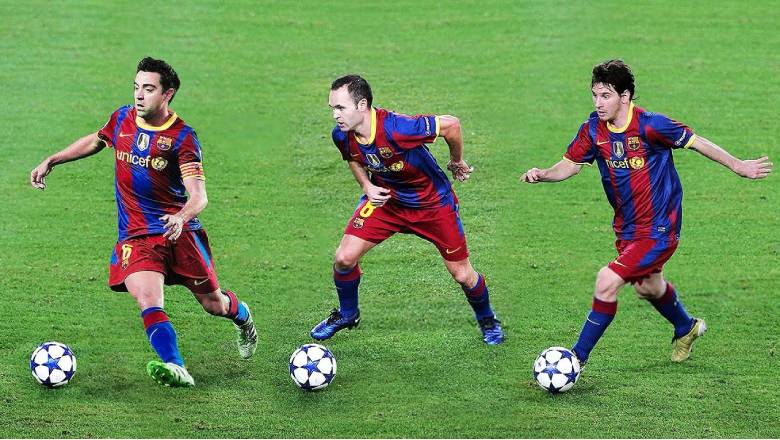
Nowgoalpro uses Ferguson’s words to represent the shared sentiment of many managers during that era when facing the nightmare of Barcelona. To understand this phenomenon, we must ask: What is tiki-taka in football? Why did it become an unstoppable force, and why was Barcelona the only club capable of pushing it to such an absolute peak?
What is tiki-taka in football?
The phrase "tiki-taka" is onomatopoeic, mimicking the sound of rapid, rhythmic passing. While often associated with the late Spanish commentator Andres Montes during the 2006 World Cup, the term was also used derogatorily by Javier Clemente to describe a style he found tedious.
However, for those who mastered it, the name represented "light, quick steps" and one-touch precision. Long before it became a global brand at Barcelona, the seeds of tiki-taka were sown in the "Total Football" of Johan Cruyff’s Ajax and Barcelona in the 1990s. Cruyff’s philosophy focused on fluidity, where players constantly swapped positions to manipulate space. Later, Louis van Gaal and Frank Rijkaard advanced this at the Camp Nou by prioritizing the "vision" of the pass, not just its speed, and integrating youth players who were technically gifted rather than physically imposing. Under their guidance, the system relied on a 4-3-3 structure where the goalkeeper was the first attacker and the forwards were the first defenders.
The philosophy officially reached its zenith between 2008 and 2012 under Pep Guardiola. In this system, every pass had to be meaningful, designed to draw the opponent out of position to create a shooting opportunity.
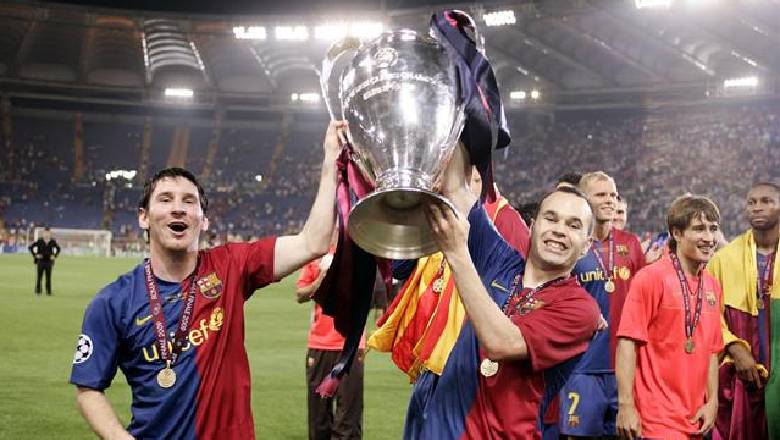
The tactical blueprint required players to create "triangles" across every zone of the pitch. To make this function perfectly, individuals needed an extraordinary level of spatial awareness, technical composure, and a "today for you, tomorrow for me" mindset. The primary engine of this machine was the midfield trio of Sergio Busquets, Xavi, and Andres Iniesta. Busquets acted as the anchor, sniffing out danger and recycling possession, while Xavi served as the "metronome," controlling the tempo of the game. Iniesta provided the verticality, using his dribbling to break lines. At the tip of this system was Lionel Messi, whose transition into the "False 9" role allowed him to drop deep, creating an overload in midfield that left traditional center-backs with no one to mark.
From 2008 to 2012, Barcelona won 14 of the 19 competitions they entered, including 2 Champions League titles and 3 La Liga trophies. Meanwhile, the Spanish national team utilized the same Barcelona core to win the 2008 Euro, the 2010 World Cup, and the 2012 Euro, becoming the first nation to win 3 consecutive major trophies.
Barcelona once went 317 competitive games without losing the possession battle. In their 2011 Champions League final win over Man United, they completed nearly 700 passes with a 90% accuracy rate. Experts marveled at the "suffocating press", if Barcelona lost the ball, they would swarm the opponent in groups of 3, winning it back within seconds. This made the tactic seemingly perfect. You could not score if you did not have the ball, and you could not keep the ball because you were being suffocated.
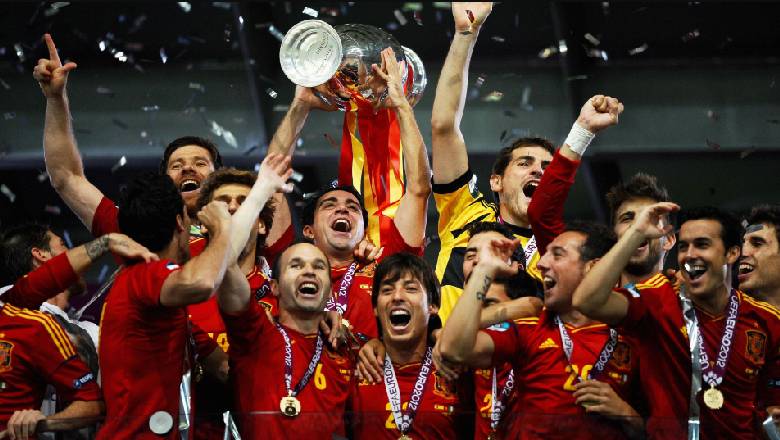
The decline of pure tiki-taka began around 2014, following Spain’s early World Cup exit and the aging of key figures like Xavi and Iniesta. Opponents eventually developed the "low block" and lightning-fast counter-attacks to exploit the high defensive line.
Today, the philosophy survives through evolution. Guardiola at Manchester City has modernized the style by adding more directness and physicality, notably adapting to the strengths of a traditional striker like Erling Haaland. This adaptation helped him secure a historic Treble in 2023. Similarly, managers like Mikel Arteta and Luis Enrique continue to prioritize possession-based systems, but with a greater emphasis on athletic intensity and verticality.
Core elements of Tiki-Taka:
Positional fluidity: Constant movement to create passing lanes and triangles.
Meaningful possession: Every pass aims to move the opponent, not just to keep the ball.
High pressing: Winning the ball back within 6 seconds of losing it.
Technical superiority: Requiring every player, including the goalkeeper, to be a playmaker.
Mental synchronicity: A collective understanding of space and timing.
This article by Nowgoalpro.net has explained the true meaning of tiki-taka and why it dominated the football world for so long. Its "perfection" was a nightmare for rivals because it turned a sport of chaos into a choreographed dance.
If you enjoyed this deep dive, why not keep Nowgoalpro in your favorites? We’re here to upgrade your sports experience with the latest on your favorite teams and coaches. Beyond the daily news, our mission is to provide neutral, fascinating analysis and deep-data stats that are truly hard to find anywhere else.
The Most Popular
-
 UEFA Champions League Final 2026 date, kick-off time, and venue
 -
 Why football is popular in Vietnam?
 -
 Which goalkeeper has conceded the most goals in football history?
 -
 Top 10 clubs with the highest average attendance in European football 2023/24: German fan loyalty shines through
 -
 What is Pedri's position at Barcelona?
 -
 All Messi’s jersey numbers: Four other numbers worn besides the famous No.10
 -
 When did penalties in football start?
 -
 Why did Xavi leave Barcelona as manager?
 -
 How much did Chelsea sell Lukaku for?
 -
 How much did Barcelona pay for Griezmann?