
How does aggregate work in the Champions League?
Navigating the knockout stages of the UEFA Champions League has never been an easy feat for any club. Unlike the "sudden death" nature of major international tournaments like the World Cup, EURO, or Copa America, where a team's fate is often decided in a single 90-minute frantic burst, the Champions League demands a higher level of psychological fortitude.
The home-and-away aggregate system transforms these ties into a supreme test of concentration and endurance. Tactical calculations must span an entire week, and a failure in the first leg is rarely the final chapter. This specific structure has birthed the "remontada" culture, where legendary comebacks have become the distinct trademark of Europe’s most prestigious club competition.
Nevertheless, the format has faced significant scrutiny over the decades, leading UEFA to implement several historic overhauls to stay relevant. To understand the modern landscape, Nowgoalpro provides a deep dive into the current mechanics and historical evolution of this system. So, how does aggregate work in the Champions League?
How does aggregate work in the Champions League?
The 2025/26 Champions League season operates under a revolutionary "Swiss Model," which has fundamentally changed the journey toward the trophy compared to the traditional 32-team group stage used since 2003. In the current league phase, 36 teams compete in a single league table rather than 8 small groups.
Each team plays 8 matches against eight different opponents, 4 at home and 4 away, accumulating points in a standard league format (3 points for a win, 1 for a draw). This phase, running from September 16, 2025, to January 28, 2026, acts as a massive filter. The top 8 teams advance directly to the Round of 16, while those finishing 9th to 24th must endure a 2-legged knockout play-off in February 2026 to secure the remaining spots.
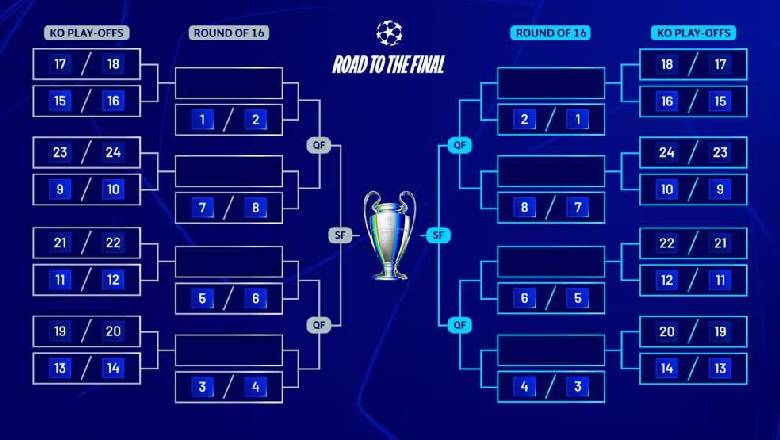
Once the competition reaches the Round of 16, the system shifts from point accumulation to the aggregate goal format. In this stage, 2 teams face each other twice. The "aggregate score" is simply the total number of goals a team scores across both the first and second legs.
For instance, if Team A wins the first leg 2-1 and the second leg ends in a 1-1 draw, the aggregate score is 3-2 in favor of Team A. However, the most significant change in the modern era, introduced in the 2021/22 season, is the total abolition of the "Away Goals Rule."
Previously, if the aggregate score was tied, the team that scored more goals at their opponent's stadium would advance. Today, every goal carries equal weight regardless of the venue. If the aggregate score is level after 180 minutes of play in the second leg, the match immediately moves into 2 15-minute periods of extra time. If the deadlock remains, a penalty shootout determines the winner.
This current system is a stark departure from past iterations. For over 50 years, starting in 1965, the Away Goals Rule was the primary tiebreaker. UEFA's original goal was to encourage visiting teams to attack rather than defend for 90 minutes. A classic example was the 2018/19 semi-final where Tottenham Hotspur advanced over Ajax despite a 3-3 aggregate draw, simply because Lucas Moura’s hat-trick was scored in Amsterdam.

While dramatic, critics like Arsene Wenger argued the rule became "overly punitive" for home teams, who often played too cautiously to avoid conceding a "double-weighted" away goal. By removing it, UEFA aims to promote more open, attacking football where teams are not terrified of a single defensive lapse at home.
Furthermore, the 2025/26 season introduces a new nuance regarding home advantage. In the knockout phase, teams that finished in the top 4 of the initial league phase are now guaranteed the privilege of hosting the second leg in both the Round of 16 and the Quarter-finals. This is a strategic reward for consistency early in the tournament, ensuring that the highest-ranked seeds have the support of their home crowd during the high-pressure closing moments of a tie.
As of today, the grand finale of the 2025/26 competition will take place on May 30, 2026, which will be hosted at Budapest, Hungary.
The Champions League aggregate & scoring system:
League Phase: Points-based (3 for win, 1 for draw) across 8 matches to determine seeding.
Knockout Phase: Determined by aggregate score (total goals from 2 legs).
No away goals: Goals scored away from home no longer serve as a tiebreaker.
Level aggregate: If tied after 180 minutes, matches proceed to extra time and then penalties.
Seeding rewards: Top league finishers earn the right to host the decisive second leg at home.
Nowgoalpro.net has just explained the intricacies of how does aggregate work in the Champions League. What is your take on the current state of the semi-finalists?
If you want to read more high-quality articles and expert analysis on the Champions League or other exciting leagues worldwide, visit Nowgoalpro and live football to the fullest. Beyond in-depth editorials, you can satisfy your passion for the king of sports as Nowgoalpro continuously updates the schedules of the world's top domestic leagues, live developments, and match results.
The Most Popular
-
 UEFA Champions League Final 2026 date, kick-off time, and venue
 -
 Why football is popular in Vietnam?
 -
 Which goalkeeper has conceded the most goals in football history?
 -
 Top 10 clubs with the highest average attendance in European football 2023/24: German fan loyalty shines through
 -
 What is Pedri's position at Barcelona?
 -
 All Messi’s jersey numbers: Four other numbers worn besides the famous No.10
 -
 When did penalties in football start?
 -
 Why did Xavi leave Barcelona as manager?
 -
 How much did Chelsea sell Lukaku for?
 -
 How much did Barcelona pay for Griezmann?